Chapter 4
I see something you can't - Where?
We're ready to go, hinges
freshly oiled - where can we shoot what?
This is where it starts to lunge out of it's technical dryness. IR is great
not only for the default setup - nice tree by lake with meadow - but for a whole
lot more motives. But hold your horses.
Every object subjected to radiation reacts to it in it's own way by absorbing
or reflecting an individual amount of waves. Highly reflective objects will
turn out quite bright in our scene while the absorbers will be very dark.
Two very big (in scale and importance) objects we will meet in the outdoors
are very strong absorbers - earth's atmosphere and water.
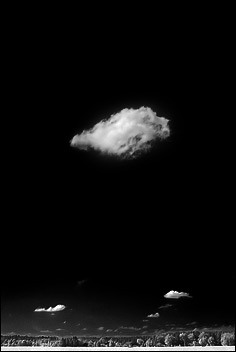
Our atmosphere is quite liberal in letting radiation pass from outer space,
much radiation will penetrate it while the other way round our "shield"
is very conservative indeed, not too much radiation is allowed out (see "greenhouse
effect").
Sky and water interact of course, the latter being a high reflector of a good
deal of visible radiation - just not infrared.
On trees and plants we will find a very reflective object on the other hand
- leafs and blossoms.
This high reflectance is also referred to as "wood-effect" which,
by no means, has anything to do with wood. The origin of the phrase goes back
to the inventor of IR and UV photography, Professor Robert Wood.
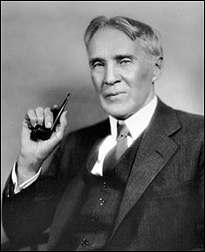 Prof.
Robert Wood (1868 - 1955), Baltimore, USA
Prof.
Robert Wood (1868 - 1955), Baltimore, USA
Wood broke the barrier into
the second invisible spectrum 1910 with his first published infrared images.
To clear another myth, the strong reflectance of leafs (hence of grass which
is a kind of leaf, too) has nothing to do with chlorophyll. Chlorophyll is transparent
to infrared radiation an lets it pass willingly. If it wouldn't, the surface
of a leaf would get very hot soon, which would not be too good for it's life
expectancy. The reason for the reflectance lies in the parenchyma which is filled
with "bubbles" of air. There the waves are being diffused an reflected
back to their origin - an effect observed with fresh fallen snow, too, when
enough air is between the ice crystals the snow has the same high reflectance
as leafs - until it's collapsed enough.
Human eyes and skin are further interesting IR-Reflectors, not too strong but
visually perceivable hence of pictorial value.
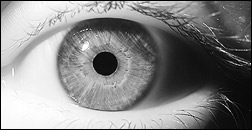
Eyes are rendered much brighter
than normal because the retina will reflect some of the infrared waves back.
Lucky us.
Skin is rendered "waxy", the different shades and colors of blood
vessels, veins, scars, spots etc. vanish - "Could you please picture me
20 years younger dear?" ;-)
All industrial manufactured toys have their IRishness hidden somewhere - be
it that some types of metal are more reflective than others or opaque covers
will be completely transparent in IR.
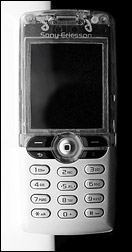
Prints do vanish most of
the time, too, leaving the photographer with a very spaced out feeling - try
a room full of screens or displays and people feverishly working in front of
them - displays do not emit or reflect any IR-radiation so what happens would
be people are sitting in front of completely black glass cubes/planes ;-) A
table full of nice prints of photos from your trusted inkjet - everything white.
Proud flags flopping in the wind - to bad there is nothing to be seen on it.
Cars - very nice, too. The later the model, the darker the glass - at Volvo
you can even order a "IR-reflecting" windscreen. Only question is
for what? Better heat insulation or better protection against the "other"
infrared photographers out there, the police?
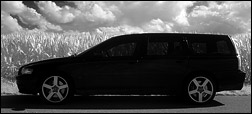
The practical side - you
don't have to glue these coated films onto your car glass - looks "cool"
right away ;-)
One thing will bring up one or the other sad face - the tale of being able to
photograph through clothing, which led to heavy sweating among the more juvenile
photographers is nothing more than - a tale. IF at all you will find a fabric
to "see through" in IR you will be able to use you eyes, too, because
then you can also see through it it the visible spectrum to make out hormonizing
details ;-)
Sun shades - quite many of them will show completely transparent in IR - quite
some fun to catch the model at making a kind of grimace behind her mirrored
shades -
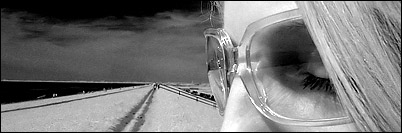
just because there is no
way you would anticipate a "trick" like this ;-)
Soft drinks and liquids in general are a very graceful subject - how about a
crystal clear coke?
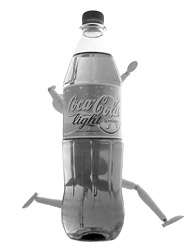
Apart from using the sun
as our one big IR-Radiator you can also use lighting yourself. Many things that
can be done with lights in the visible spectrum are possible in IR, too. The
easiest method is using flashes - gel filter put before it so no visible light
can escape and you are ready to use an "invisible" flash -fun stuff.
The flash unit has to be either optimized for firing into the IR or really strong
- else you'd have to be quite close to the subject.
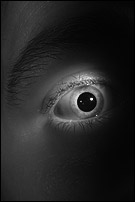
Even easier than flashes are special IR-flashlights, available at your hunting-
or military supply store in different sizes / power. The image of my eye above
is done with a mixture of the flashlight very dominant and a flash very softly
- the interesting bit here would be the big pupil because it can't see any light
so the aperture stays wide open ;-)
Summary:
There is no need to limit
oneself to the usual tree along the water images - even though still one of
the finest possible IR-imagery. There is a wide range of interesting objects
and viewing angles to be discovered by you - be inventive, leave trodden tracks.
If you come home with a nicely filled flash card all you need to do is process
the images - a little example on how to do that is following in the next chapter.